What Is Empathic Development? Why the Way We Design Neighborhoods Needs to Change
published February 20th, 2026
Walk through almost any new North American suburb built in the last fifty years and you’ll notice the same thing: the houses are large, the streets are wide enough to land a Boeing, and there isn’t a lot of visible community life. There are few gathering places. There’s nowhere to sit. The architecture is uniform and generally colorless and there isn’t a whole lot to look at that’s worthy of a ‘wow’. People drive up to garage that consumes the façade of the front of their home, park, and disappear inside. The neighborhood, as a place in itself, barely exists.
This isn’t an accident, of course. It is the direct result of how governments and developers regulate, plan and build communities.
For decades, development in North America has been guided by a set of principles that prioritize regulatory compliance over the human experience. Municipal zoning codes define setbacks, height limits, lot coverage calculations, use separations, etc.. They describe the boundaries of what is permitted but say nothing about what is beneficial. Developers are motivated to work within those limits because the zoning code is their rulebook and adhering to those rules is their best hope for a quick permit. The result is a built environment that is technically compliant and deeply uninspiring.
Empathic Development is our response to that problem.
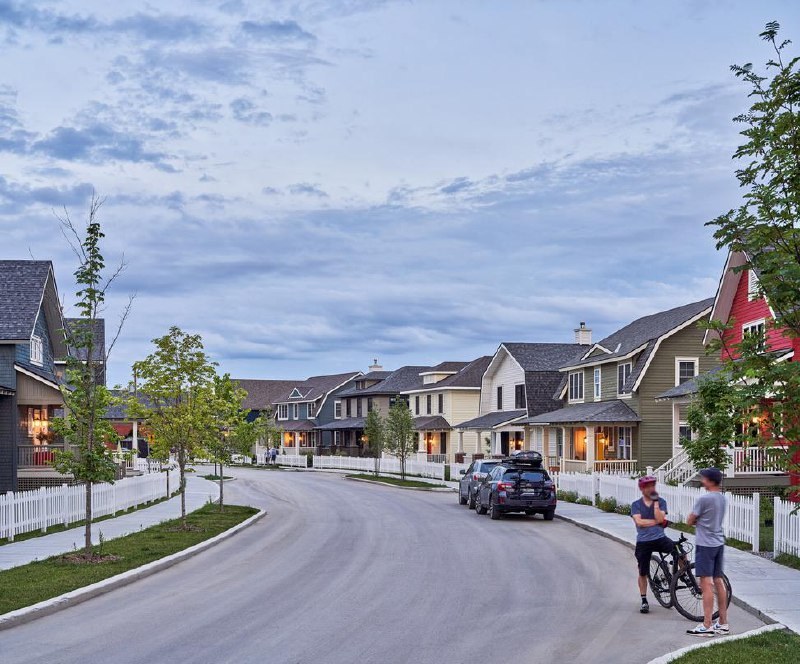
The term is simple: empathic development means designing places by imagining how people will actually experience them. It means asking, before a single line is put to paper, what it will feel like to walk down that street, to sit in that park, to watch your children play in that square. What will it feel like to drive into that neighborhood knowing that it’s home and what needs to be included in the community to make it complete. It means taking the natural features of the land seriously—not as obstacles to be bulldozed, but as amenities to be preserved and designed around. It means ensuring that a neighborhood provides housing options for people at all stages of life, from young families just starting out to seniors who want to remain connected to the community they’ve lived in for decades.
None of this is new. Walk through Savannah or Charleston or Quebec City—cities built before the car, before modern zoning, before the regulatory machinery of contemporary development—and you’ll see empathic development at work. Streets were designed to human scale, buildings are close to the sidewalk, porches face the street, parks and squares are central and within walkable distance. These cities were built to be lived in and people have been living in them happily for hundreds of years. The fact that they are now also among the most desirable places to invest in real estate should not come as a surprise. They’re beautiful and people want to be in places that are beautiful.
The problem is that modern urban planning has largely stopped designing inspiring communities. The knowledge exists and the desire is there: When asked, most people would describe their ideal neighborhood using exactly the words we’ve used above. There is a considerable gulf between what people want and what the development industry provides.
Landlab has spent more than twenty-five years trying to close that gap. None of our developments are built to an off the shelf municipal zoning code. They’re designed around the people who will live in them: where they’ll walk, how they’ll gather, what they’ll see from their front door. We preserve natural features. We mix housing types. We design streets for pedestrians first and cars second. The happy irony for government, of course, is that re-writing the zoning code has meant huge boosts to their tax base. It turns out that nicer neighborhoods are better for municipal revenue too!
Good places are designed with empathy for the people who will use them. That has been the unwritten rule for successful places around the world for hundreds of years. It shouldn’t be novel here.